NEWS → · Providers · Amazon AWS
AWS Lambda now runs GPU functions — serverless inference on EC2 G-series at the EC2 rate plus 9.75%
Nov 18, 2026
Amazon announced on Nov 18, 2026 that AWS Lambda now supports GPU instances for Event Functions running on Lambda Managed Instances — generally available the same day. You ship a container image, Lambda provisions and scales the GPU capacity behind it, and the bill is the underlying EC2 instance fee plus a 9.75 percent management fee for GPU instances and the standard Lambda request fee of $0.20 per million requests. The launch families are the EC2 G-series (G4dn, G5, G6, G6f, Gr6, Gr6f and G6e), and AWS positions the feature plainly: optimised for inference rather than training, and for custom models rather than large foundation models.
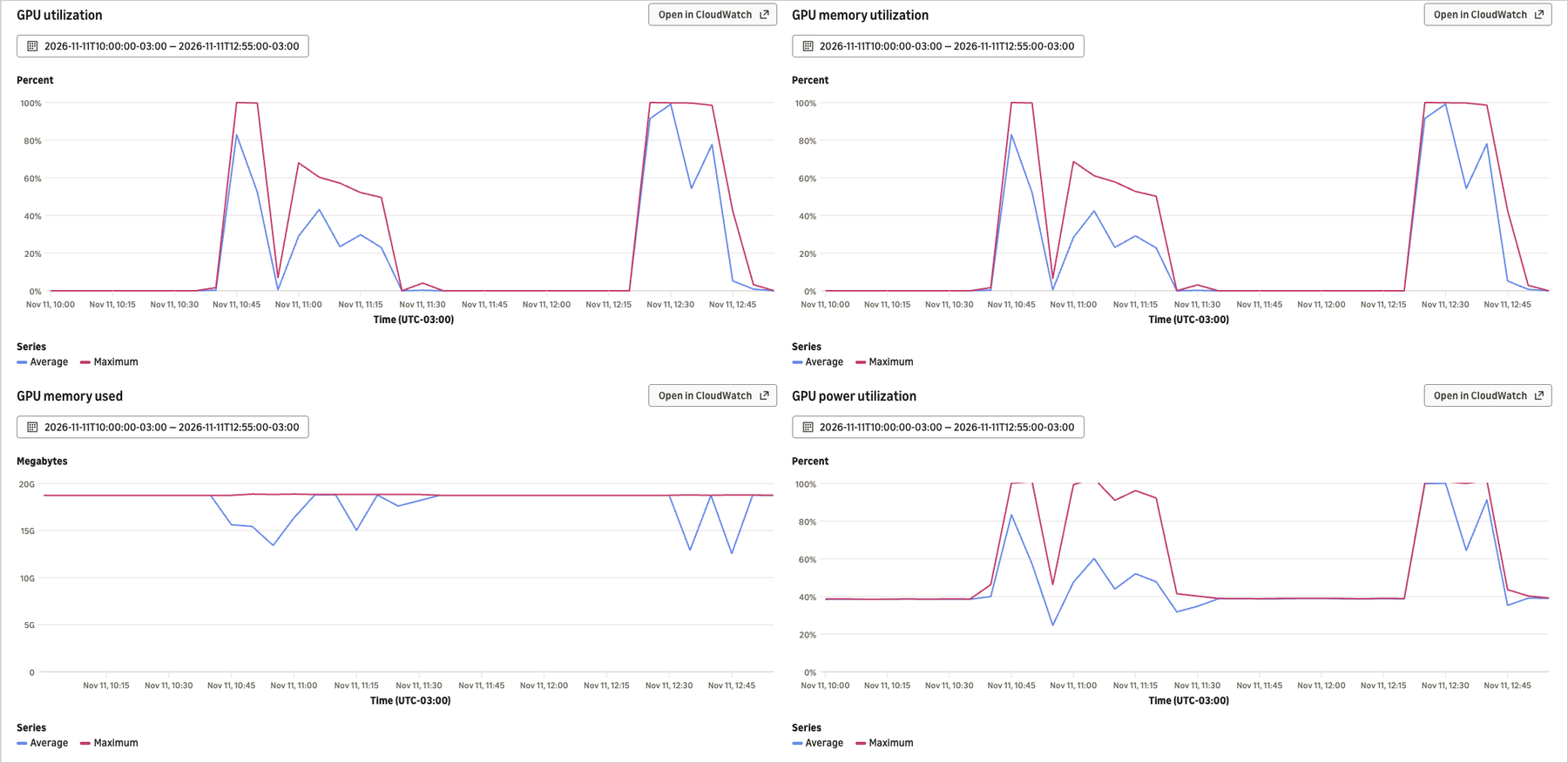
Image: Amazon Web Services via aws.amazon.com
How it works, from AWS's own announcement post, read first-hand: GPU-accelerated functions are deployed as container (OCI) images of up to 32 GB, with up to 32 GB of ephemeral storage, 2,048 to 32,768 MB of memory and 3 to 48 GB of accelerator memory; each execution environment can serve up to 48 concurrent requests, a capacity provider can scale to 15,000 vCPUs, and the extended timeout reaches 90 minutes for asynchronous and event-source invocations. Lambda supplies curated base images — including vLLM and SGLang serving images — and handles drivers, CUDA versions, provisioning and routing. In AWS's own worked example, a Qwen2.5-1.5B-Instruct model went from a Hugging Face model ID to a live OpenAI-compatible endpoint in about 10 minutes, with no inference code written (AWS's figure, from its own demo). One practical catch is in the same post: new accounts may start with a G-series quota of 0 and must request an increase before anything runs.
The pricing structure is the part renters should note, because AWS prints it in the announcement itself: the EC2 instances run On-Demand, existing Savings Plans and Reserved Instances apply to the instance fee, and an EC2 On-Demand Capacity Reservation can be matched to a capacity provider for predictable availability. On top of the instance fee sit the 9.75 percent GPU management fee and $0.20 per million requests — there is no per-token or per-second GPU price of AWS's own here, so the effective cost of an inference still depends on how well concurrent requests pack onto the GPU you are paying for, which is exactly what the per-environment concurrency setting (up to 48) is for. AWS says GPU utilisation and memory metrics appear in CloudWatch and the console alongside standard function metrics.
What it means if you rent GPUs
For model builders this is a new shape of GPU rental from the largest cloud: not an instance you keep, but a function that happens to run on a GPU, triggered by the same 200-plus AWS event sources as any Lambda function and billed off published EC2 rates plus a stated percentage. The honest limits are AWS's own: the G-series is the small-to-mid inference tier (3 to 48 GB of accelerator memory per function), the feature is for inference and custom models rather than training or large foundation models, and the headline price is a structure, not a number — your real cost per request is set by utilisation, the same arithmetic that decides whether any rented GPU is cheap. Against the serverless-GPU specialists, AWS's offer is integration and the EC2 rate card; against raw EC2, it is the 9.75 percent that buys you not operating the fleet. We are adding Lambda GPU functions to our provider watch on those stated terms; no Lambda rate sits on our price board, because AWS publishes no single GPU hourly rate for this feature — the board only carries rates we can verify as numbers.