NEWS → · Models · NVIDIA
NVIDIA opens four Cosmos 3 Nano checkpoints — 16B world models for driving and robot simulation
Nov 6, 2026
Published by NVIDIA on Hugging Face on Nov 5, 2026: four post-trained Cosmos 3 Nano checkpoints, 16 billion parameters each, under the OpenMDW 1.1 licence that permits commercial use — world models that generate synchronized camera video and LiDAR for driving, and video from robot actions, sized to run on a single rented GPU.
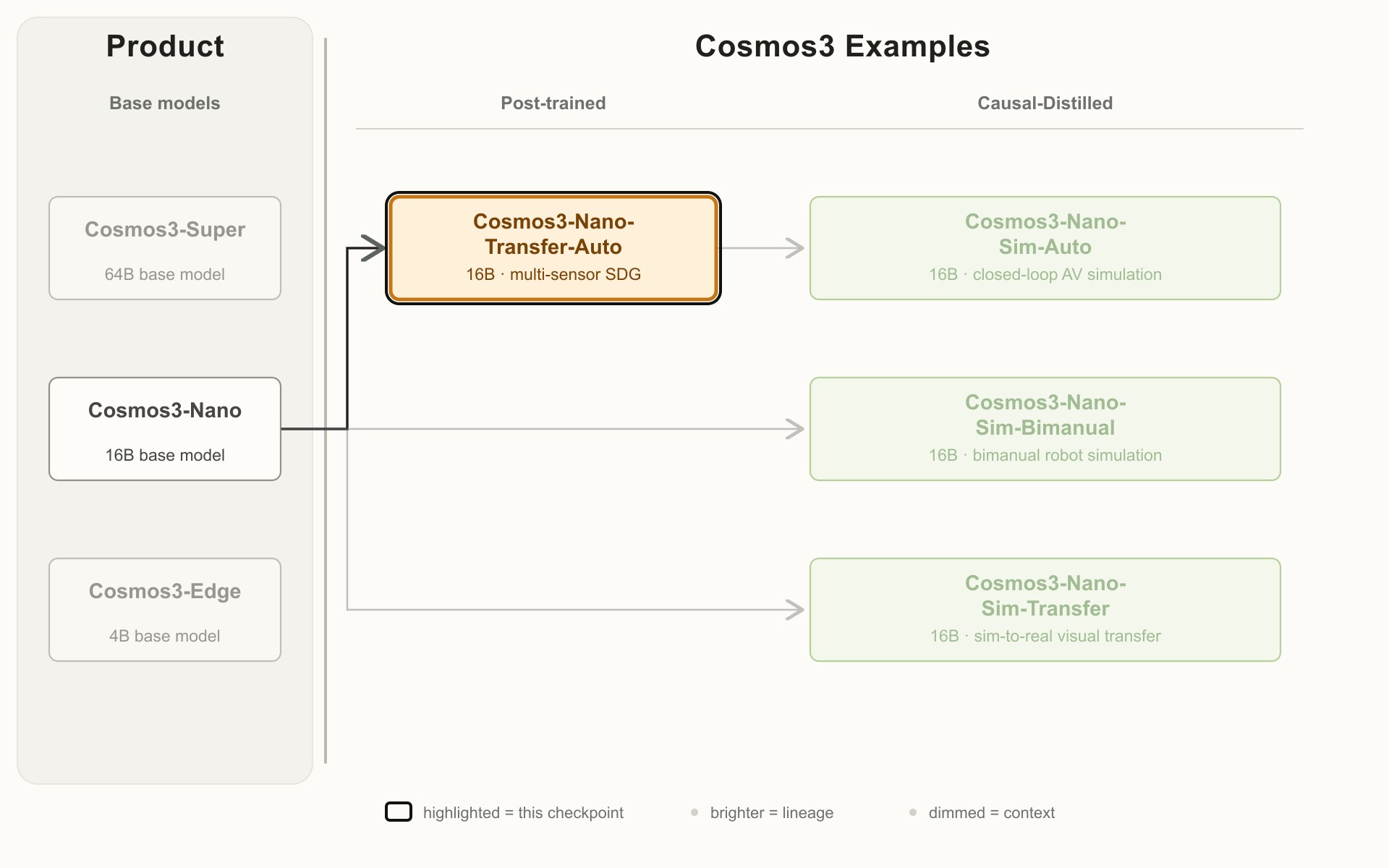
Image: NVIDIA via huggingface.co
What was released, from NVIDIA's Hugging Face announcement of Nov 5, 2026 and the Cosmos3-Nano-Transfer-Auto model card, both read on Nov 6, 2026: four checkpoints, each a post-trained example of Cosmos 3 Nano with 16B trainable parameters. Transfer-Auto generates synchronized multi-view driving video (up to 11 camera views, including fisheyes) with joint LiDAR output, varying weather, lighting and time of day. Sim-Auto is its streaming variant, generating camera and LiDAR observations in small chunks as driving controls change. Sim-Transfer turns a physics simulator's controls and a text prompt into photorealistic video. Sim-Bimanual predicts video from a two-arm robot's actions, for YAM and AgiBot embodiments.
The licence and the size are the renter story. All four use OpenMDW 1.1, which NVIDIA states permits commercial and non-commercial use under its terms — read the terms before production use, as with any open licence. At 16B parameters the weights are about 32GB in BF16 and about 16GB at 8-bit; NVIDIA's own technical material puts Cosmos3-Nano generation at 58 GiB of GPU memory in BF16, 44 GiB in FP8 and 31 GiB with FP8 plus offloading (NVIDIA-reported figures, from its Nov 2 technical blog). That is one ordinary rented card — an L40S or an A100 — not a cluster: world-model teams can now test NVIDIA's driving and robotics stack on the cheapest tier of our board.
The honest limits, from the announcement itself: these are post-trained examples meant as starting points for adaptation to your own sensor rig and domain, not finished products; the published serving setup was tested on one GB200, which is a test rig, not a minimum specification; and no one outside NVIDIA has yet published independent quality measurements for the checkpoints. The post-training recipes for all four stages — bidirectional adaptation, teacher forcing, consistency distillation and self-forcing — are published alongside the weights, so the adaptation path is part of the release.
What it means if you rent GPUs
Cosmos is NVIDIA's platform for teaching machines about the physical world, and until now its newest checkpoints were the part you read about rather than downloaded. Four 16B open checkpoints change who can experiment: a driving-data or robotics team with one rented GPU can generate synchronized camera-and-LiDAR scenes this week, at single-card prices, under a licence that allows commercial work. The frontier open-weight race this autumn has mostly been trillion-parameter language models; this is the same opening-up, at the opposite end of the size scale.