NEWS → · Models · Baidu
Baidu opens ERNIE 5.5 Flash Base — a 280B open-weight base model with a licence that stops at three borders
Nov 5, 2026
Baidu has published the weights of ERNIE-5.5-Flash-Base on Hugging Face: a 280-billion-parameter sparse mixture-of-experts model, released deliberately at the end of pre-training — before any instruction tuning — as a starting point for other people's fine-tunes. It is Baidu's first open-weight release at this scale in about 16 months, and its custom licence is the part to read before the download finishes.
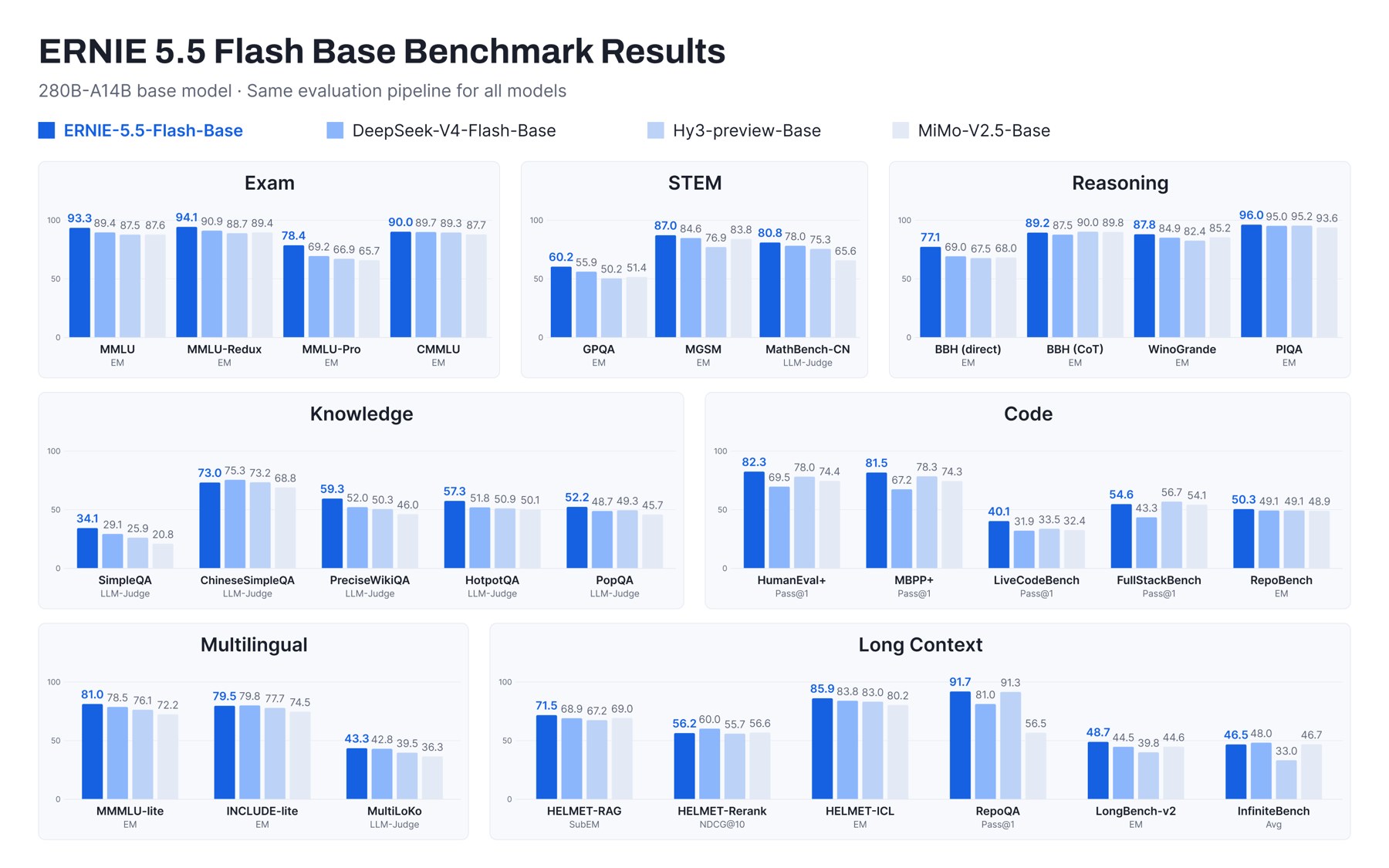
Image: Baidu via huggingface.co
What is out, verified on Baidu's own Hugging Face repositories (baidu/ERNIE-5.5-Flash-Base and its BF16 twin, read Nov 5, 2026): a text-only MoE base model with 280 billion total parameters and 14 billion active per token, pre-trained from scratch on 33.5 trillion tokens with the Muon optimizer. The architecture is 43 layers — 37 of heavily compressed attention (one cache entry per 128 tokens) and 6 of latent attention with sparse attention — with 512 routed experts per MoE layer, 10 selected per token. Training context reached 128K tokens; fine-tuning and inference support 1 million. Two checkpoints are public: the FP8 build (128 shards, 304,360,870,583 bytes of storage on Hugging Face) and a BF16 build (572,984,599,112 bytes). The card documents serving with SGLang and vLLM, and Baidu says a post-trained ERNIE 5.5 Flash will follow — what is out today is a base model with no chat tuning, no refusal behaviour and no tool format built in.
The scores are Baidu's own, run — the card states — under one unified pipeline against DeepSeek-V4-Flash-Base, Hy3-preview-Base and MiMo-V2.5-Base, and reported here as the maker's claims, not independently reproduced: MMLU 93.3, MMLU-Pro 78.4, GPQA 60.2, HumanEval+ 82.3, LiveCodeBench 40.1 and LongBench-v2 48.7, leading most of the 30-benchmark table. It is not a clean sweep on Baidu's own numbers — Hy3-preview-Base leads FullStackBench and DeepSeek-V4-Flash-Base leads InfiniteBench — and the comparison set is each rival's publicly released base checkpoint rather than its newest model, a caveat trade coverage of the release also flagged.
The licence, read in full (ERNIE 5.5 Flash Base Model License Agreement v1.0, dated Nov 5, 2026): this is a custom licence, not Apache 2.0 as ERNIE 4.5 used. Its Territory is the whole world except the European Union, the United Kingdom and South Korea — use, modification and distribution outside that territory are not authorised at all. Non-commercial use is free of licence charges. Commercial use at or below $50 million in annual revenue from related products or services needs a one-time notice to Baidu and a prominent “Powered by ERNIE” display; above $50 million it needs Baidu's separate written authorisation before use. And the materials, derivatives or outputs may not be used to improve an unrelated AI model. Any team in London, Berlin or Seoul, and any hosted service built on top, has to stop at those clauses before the hardware question even starts.
What it means if you rent GPUs
Why this matters to anyone who rents GPUs: the week's open-weight story has been size — a 1.56TB frontier checkpoint on Monday's board maths, a one-GPU 65B model yesterday. ERNIE 5.5 Flash Base sits between them and points at a different job: not serving a finished assistant, but renting GPUs to train one. The FP8 checkpoint is about 280GB of weights, so the card's own four-way serving recipes fit on four large cards — at the rates we checked this morning, four H200s on RunPod Secure at $5.29 an hour per card is about $21 an hour to hold and serve it, and the BF16 build (about 573GB) doubles the memory before fine-tuning state is counted. Fine-tuning a 280B base is the real rental event here, and it is exactly the workload the licence's revenue threshold and territory limits will shape: a well-funded lab outside the excluded regions gets a strong, fixed pre-training baseline for the cost of its own post-training run; a lab inside them gets nothing, however cheap the GPUs are. We have added the model to the catalogue with its licence terms stated plainly.