NEWS → · Providers · Hugging Face · OpenRouter
Hugging Face hands its inference routing to OpenRouter — and your own provider keys stop working
Nov 16, 2026
Hugging Face has switched Inference Providers — the service builders use to call open-weight models hosted by outside providers — from its own custom router to OpenRouter's. Language-model requests now go to whichever of more than 80 providers offers the best live mix of price, speed and reliability, and a failed call is retried on another provider inside the same request. The trade-off is a breaking change: you can no longer use your own provider API keys for language models.
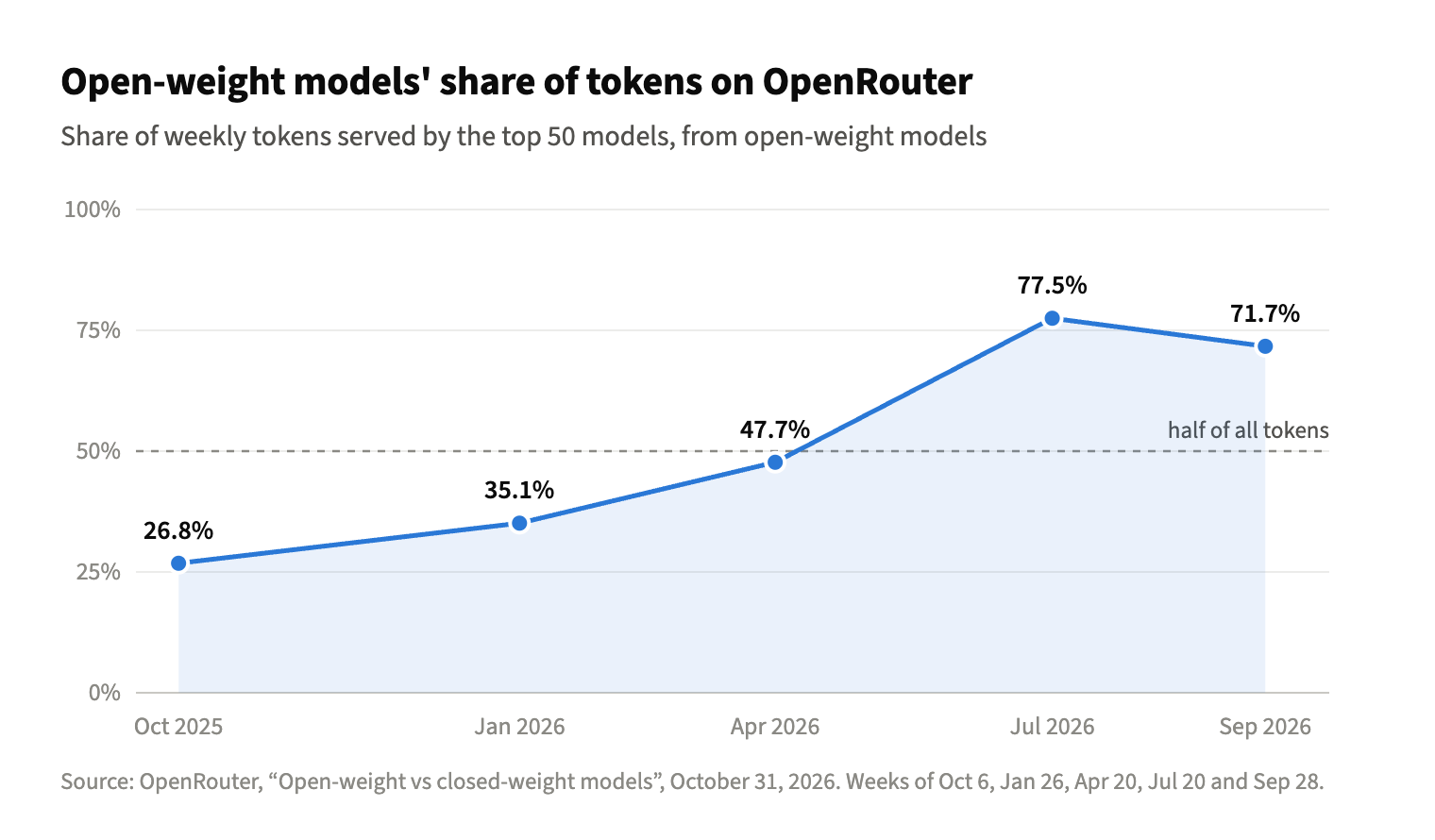
Image: Hugging Face via huggingface.co
What changed, from Hugging Face's own blog post published Nov 16, 2026 and read first-hand: every open-weight model on the Hub that a provider serves can now be called with a Hugging Face token through the same API, with the provider picked per request. OpenRouter serves more than 800 trillion tokens a month to over 10 million users, across 600+ models from 80+ providers; OpenRouter's own announcement puts 160 models from 38 labs live on Hugging Face this way today. Its recently rebuilt routing — which scores providers on live price, speed and reliability instead of lowest list price alone, and moves traffic away from a provider that slows down or starts failing — cut capacity errors by 46% and improved time to first token by 16.9% and throughput by 16.3% in OpenRouter's measurements; OpenRouter's post adds that the rebuilt routing cost 6.0% more per request in its October experiment. Builders can still steer with a suffix on the model id (:cheapest, :fastest, or a named provider), routing is cache-aware so a conversation stays on the provider holding its prompt cache, and model pages gain Providers and Metrics tabs showing each provider's live price, speed and uptime. Pricing itself does not change: you pay the provider's price on your Hugging Face bill, with no Hugging Face markup on top.
The breaking change is stated plainly by Hugging Face: because language-model requests now go through OpenRouter and are billed to your Hugging Face account or organization, custom provider keys no longer work for those models — you can still pin a provider by suffix or switch providers off in settings, and your code stays the same. Image, video and audio generation are untouched: they keep running directly through Inference Providers, and custom keys for image and video providers keep working. Hugging Face also published the usage picture behind the move: open-weight models rose from 26.8% of the tokens OpenRouter served in October 2025 to 71.7% at the end of September 2026, peaking at 77.5% in July, with weekly open-weight volume up more than 60-fold in a year. This week's most-used model on OpenRouter is an open-weight one — DeepSeek V4.1 Flash 1017, at 59.2 trillion tokens — and Hugging Face puts open-weight models at about a quarter of the closed-model price on average: $0.28 per million input tokens and $1.62 per million output, against $1.27 and $6.36.
What it means if you rent GPUs
For model builders this is the serving layer consolidating in public: the Hub where open weights are published now rents its request routing to the largest multi-provider gateway, which means the provider behind a Hugging Face call is chosen by live measurements, not by the caller's own key or contract. That is good news for reliability — a failing provider no longer fails your request — and it makes the per-provider price, speed and uptime tables on each model page a genuinely useful comparison surface. It is also a real loss of control for teams who negotiated their own provider deals: those keys, and any pricing attached to them, no longer apply to language models on Hugging Face. The numbers in the announcement underline why this desk tracks open weights so closely: at 71.7% of tokens on the biggest gateway, open-weight serving is no longer the alternative route — it is most of the traffic, and the cheapest verified way to run those same models yourself is the board we check every day.