NEWS → · Models · Thinking Machines
Inkling 2 Mini weights are out: a looped 26.4B that ships in a single 20GB checkpoint — and leads its class at agentic coding
Nov 20, 2026
Thinking Machines Lab released Inkling 2 Mini with open weights today, Nov 20, 2026, under Apache 2.0 — a looped mixture-of-experts model whose middle layers run three times per token, giving 48 layer visits from 24 stored layers. The model card, read first-hand by this desk, totals 26.4 billion parameters with 3.4 billion active per token (5.4 billion effective once looping is counted), takes text and image input, carries a context window of up to 1 million tokens, and ships as a single checkpoint of about 20GB in its native NVFP4 and MXFP8 precisions — no conversion loss, because it was trained in the precision it ships in. The card's own hardware floor is one DGX Spark, an Apple silicon machine with 32GB or more, or another GPU with 32GB or more of memory recommended. The picture is Thinking Machines' own architecture diagram from the release.
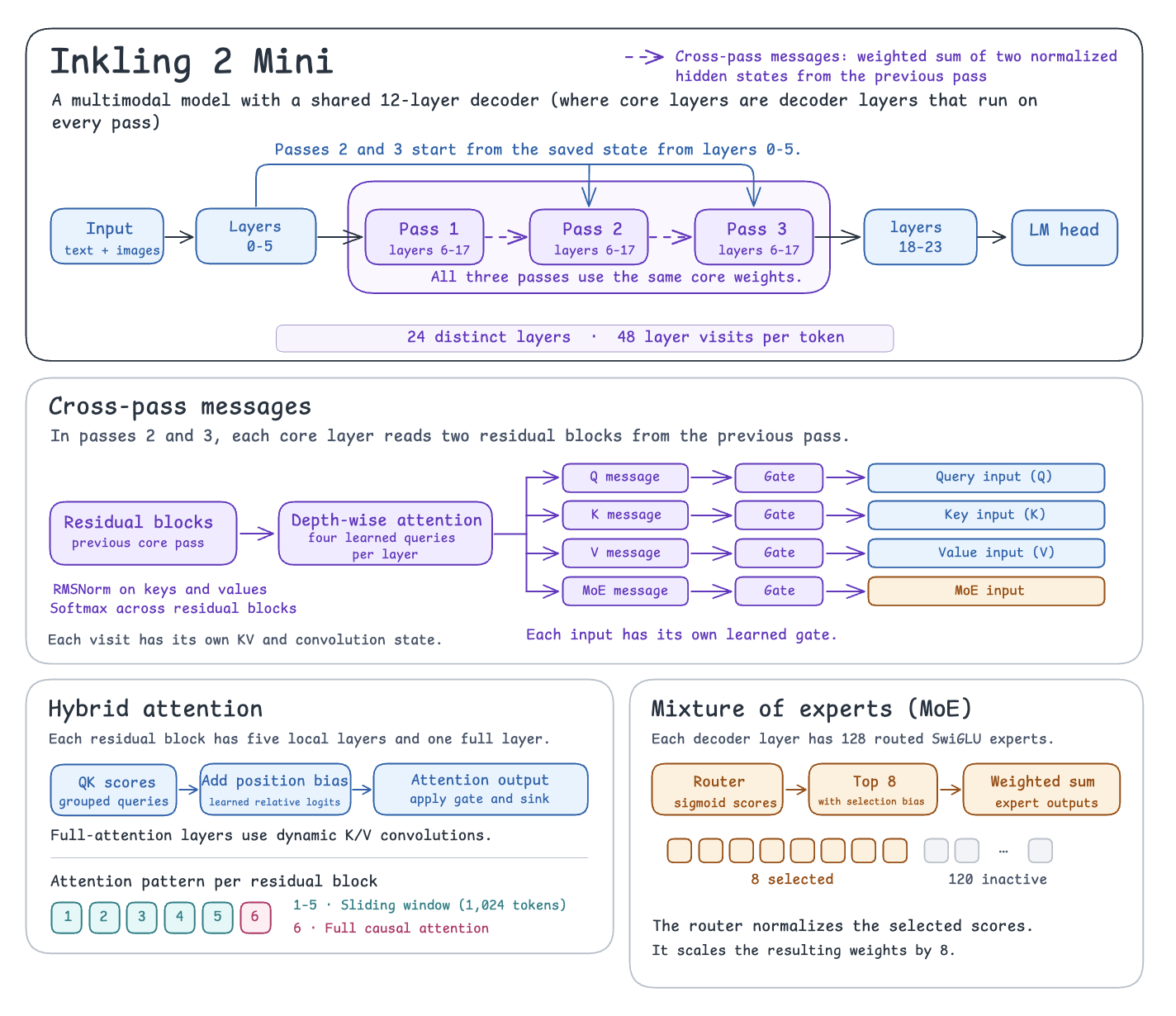
Image: Thinking Machines Lab via huggingface.co
What was released, from the announcement and the model card: a 24-layer decoder whose middle 12 layers repeat three times with shared weights; each token routes to 8 of 128 experts; attention is a hybrid of local and global layers; a vision transformer feeds images into the same hidden space. Alongside it sits a research variant, TML-d24-varloop-research, which lets researchers vary the loop count from one to five passes — the lab is explicit that one reason for this release is to let the community study whether looped models stay monitorable, and its own tests found the chain of thought stayed legible as loops rose while no-CoT reasoning improved (the variable-loop model's no-CoT time horizon rose from 16 seconds at one pass to 37 at three). Serving support is there on day one: vLLM, SGLang, Hugging Face Transformers, TokenSpeed, NVIDIA Dynamo, Unsloth and llama.cpp GGUF builds, and Ollama on Apple silicon. The weights are also on the lab's Tinker platform for inference and customisation. As with its sibling, the card links the lab's Model Acceptable Use Policy alongside the Apache 2.0 licence.
The benchmark claims are the lab's own tables, printed here as its measurements, not independent results: Inkling 2 Mini leads every open-weights model under 100B total parameters on DeepSWE v1.1 (48.2%) and the Vals Index v2.2 (46.5%) in Thinking Machines' comparison, scores 79.2% on SWE-bench Verified, and ties the dense Qwen3.8-27B at 20.1 on the Artificial Analysis Intelligence Index — a 27B dense model matched by a 3.4B-active MoE, on the lab's numbers. One third-party data point exists: Stanford researchers with early access measured intelligence per watt on a DGX Spark (128GB) and scored Inkling 2 Mini 0.703, ahead of Qwen3.6-35B-A3B at 0.430 and Gemma-4-26B-A4B at 0.159 in their study. The card is equally plain about the weak spots, and they are printed here too: multi-turn chat and many-constraint instructions trail Qwen3.8-27B (50.0% on MultiChallenge, 33.4% on ComplexConstraints in the lab's table), factual knowledge is bounded by the model's size, and support for looped models in local runtimes is new, so speeds vary by runtime and hardware — the card's own warning.
What it means if you rent GPUs
For renters this is the opposite end of the Inkling family from its sibling. Inkling 2 Small, whose weights landed on Nov 12, is a cluster rental — its cheapest verified way in was $14.36 an hour. Inkling 2 Mini is a single-card job: the checkpoint is about 20GB as shipped, and while that file would physically fit a 24GB card, the maker's own recommendation is 32GB or more — the headroom is what the KV cache eats, especially anywhere near the 1M-token context. On the board's checked prices of Nov 20, 2026, the cheapest verified 32GB-class door is an RTX 5090 on RunPod Community at $0.69 an hour (RunPod Secure lists $1.39), and an RTX PRO 6000 — 96GB, room for long contexts and bigger batches — starts at $1.69 on RunPod Community and $1.80 on Nebius. Run it at full precision instead and the arithmetic changes: 26.4 billion parameters at two bytes is about 53GB of weights, one 80GB-class card. The model is now in our catalogue with its sizes worked from the card. A deployment guide — how to run Inkling 2 Mini and what it actually costs, against the dense 27B it ties — is proposed to the editor, not published by this sweep.