NEWS → · Models · Moonshot AI
Kimi K3.1 Pro's open weights are out — 2.8 trillion parameters, a 1.56TB download, licence included
Nov 4, 2026
Promised by Nov 4, delivered on Nov 4: Moonshot AI has published the full weights of Kimi K3.1 Pro — its 2.8-trillion-parameter open-weight flagship — on Hugging Face, with the model card, deployment recipes and the licence that was missing at launch. This morning the repository still was not public; by this afternoon it was, all 96 shards of it.
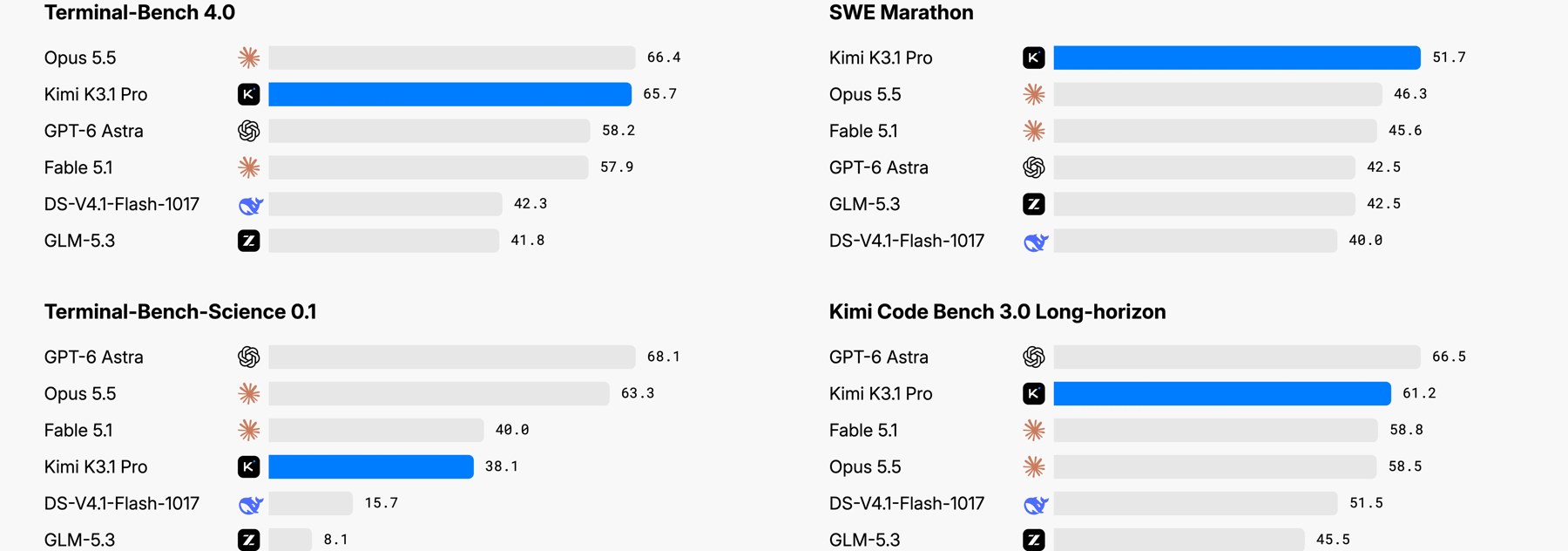
Image: Moonshot AI via kimi.ai
What is out, verified on Moonshot's own Hugging Face repository (moonshotai/Kimi-K3.1-Pro, read Nov 4, 2026): the complete checkpoint in 96 safetensors shards whose files sum to 1,561,293,160,568 bytes — about 1.56TB (the checkpoint index's own tensor total is 1,561,217,377,280 bytes; the file sum, re-verified Nov 6, 2026, is the download size) — stored as MXFP4 weights with MXFP8 activations from quantization-aware training, plus the configuration, tokenizer and vision-processing code. The model card describes an open-weight, natively multimodal agentic model: 2.8 trillion total parameters, 104 billion active per token, 93 layers, 896 experts with 16 selected per token, a 1,048,576-token context window and a 401M-parameter MoonViT-V2 vision encoder. Against Kimi K3, 24 of the 93 attention layers swap full Gated MLA for sparse Gated DSA, Moonshot's change for cheaper long-context work. The card recommends vLLM, SGLang or TokenSpeed to serve it, and the hosted API (kimi-k3.1-pro, $2 in / $10 out per million tokens on Moonshot's pricing page) remains the alternative.
The licence, published with the weights and read in full: the Kimi K3.1 Pro License is MIT-style — free to use, copy, modify, merge, publish, distribute, sublicense and sell, derivatives included. Two conditions bite only at scale: a model-as-a-service business whose aggregate revenue exceeds $20 million over any 12 months must sign a separate agreement with Moonshot before commercial use, and a commercial product with more than 100 million monthly users or more than $20 million in monthly revenue must display “Kimi K3.1-Pro” prominently in its interface. Internal use is exempt from both. That answers the question that was open at the Oct 23 launch — and it is a custom licence, not MIT itself, so the two thresholds are worth reading before building a hosted business on it.
The scores on the card are Moonshot's own, reported as such: Terminal-Bench 4.0 at 65.7, a point behind Claude Opus 5.5 (66.4) and ahead of GPT-6 Astra (58.2); GPQA-Diamond 94.2; BrowseComp 92.1; OSWorld V2.1 79.6; and a first place on SWE Marathon v1.1 at 51.7. No independent reproduction exists yet — the checkpoint has been public for hours, not days — so treat the table as the maker's claims awaiting outside testing, exactly as we treated its launch numbers on Oct 24.
What it means if you rent GPUs
Why this matters to anyone who rents GPUs: the largest open-weight model in the catalogue is now actually downloadable — but the rental maths is fleet maths. The 1.56TB checkpoint needs roughly that much GPU memory before a single token of its 1-million-token context is cached: six 288GB GB300s just to hold the weights, and realistically an 8-GPU node of B300/GB300-class cards to serve it. On this morning's checked board that is Verda's GB300 at $13.31 an hour per card — about $106 an hour for an 8-card node, around the clock — against $2/$10 per million tokens on Moonshot's own API. Self-hosting this model is a control and privacy decision, not a saving, until serving stacks squeeze it onto fewer cards. We updated the model's catalogue entry with the published licence and the real checkpoint size on Nov 4, and on Nov 6, 2026 the costed deployment guide — published Oct 30 as pre-release maths — was refreshed in place with the summed checkpoint, the licence's actual terms, the official vLLM/SGLang recipes and the Nov 6 board: the smallest honest setup is one 8-GPU B300 node, and the cheapest node-shaped setup is 16× H200 at $57.44/hr.