NEWS → · Models · Aleph Alpha
Kolibri 1.1: Aleph Alpha's sovereign 75B MoE claims 3.4× less GPU time per task
Nov 23, 2026
Aleph Alpha released Kolibri 1.1 on Nov 23, 2026, its German–English sovereign open-weight model: 75 billion total parameters, 3.44 billion active, Apache 2.0. The pitch is serving cost — a new sparse-attention design and leaner reasoning that the maker says cut GPU time per task by 3.4× against Kolibri 1.0. The picture is Aleph Alpha's own chart from the model card: benchmark score against GPU-hours per 1,000 tasks, with 1.1 on the efficiency frontier at 73.2 points and 0.21 GPU-hours where 1.0 needed 0.72.
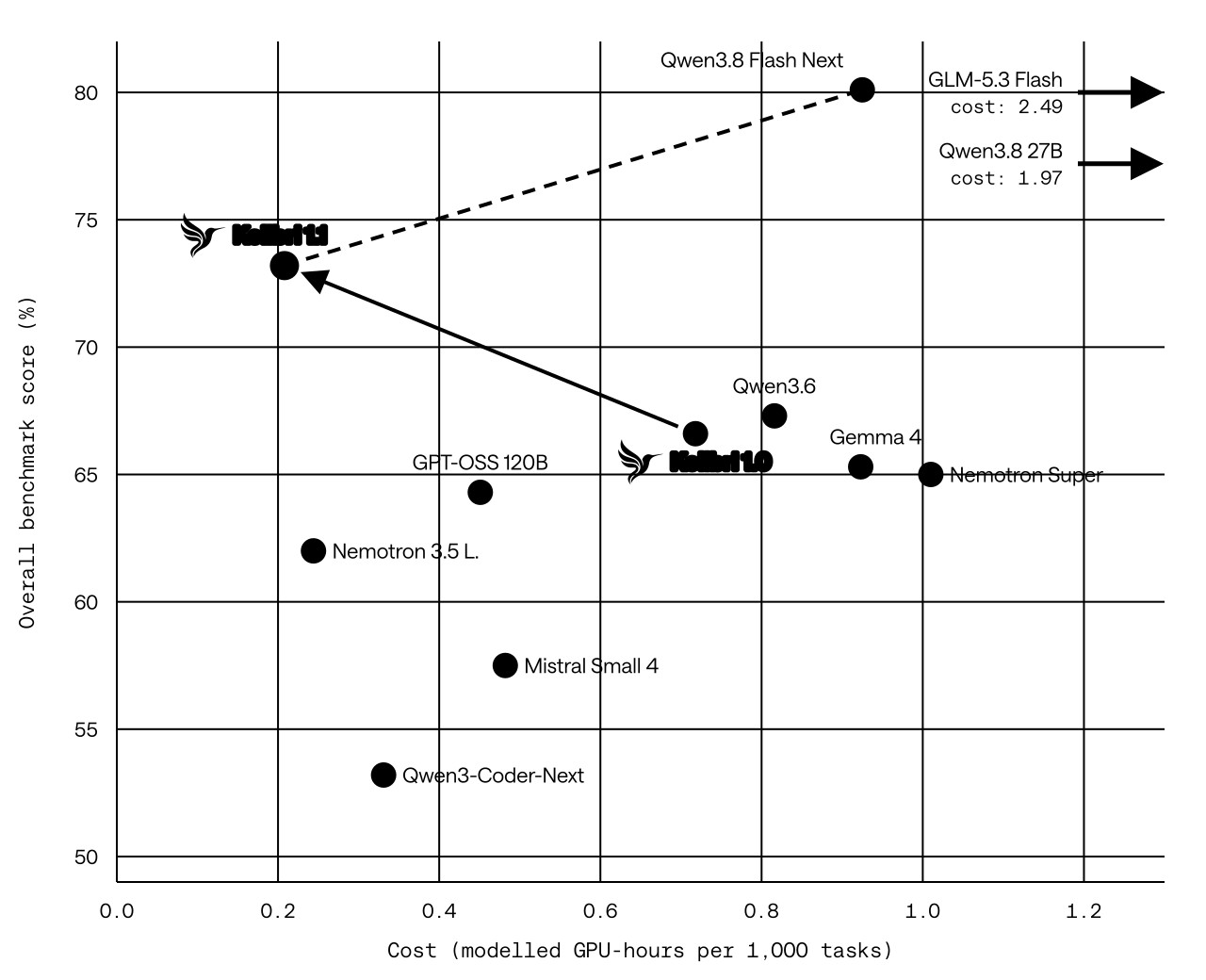
Image: Aleph Alpha via huggingface.co
What shipped, from the model's Hugging Face card and Aleph Alpha's own release, both read first-hand: each token attends to the 2,048 most relevant plus the 128 most recent tokens, layers share KV cache, and the model emits about 41% fewer output tokens per task; native context is 262,144 tokens (1,048,576 maximum, with up to 262K recommended). The efficiency figures are the maker's own modelling from vLLM 0.33 throughput on one 8 × B200 node with 8-bit weights — 0.208 against 0.718 GPU-hours per 1,000 tasks — not an independent measurement. The honest counterweight is on the same card: its τ-bench average fell against 1.0 (67.1 against 69.7), and below 8K of context 1.1 decodes slower than 1.0. The weights take about 77.6 GB; the card's minimum serving shapes are 2 × H100 SXM, 2 × H200, 1 × B200 or 1 × B300, and official GGUF builds ship alongside for llama.cpp.
Context: Kolibri 1.0 arrived on Oct 3, 2026, so this is a seven-week iteration, and it lands after the September agreement to combine Cohere and Aleph Alpha — background reported by secondary sources, printed here as context, not as part of the release.
What it means if you rent GPUs
A brief, deliberately: Kolibri is a niche sovereign-European model, not a general renter headline — but its claim is exactly this desk's home ground, cost per task. A 75B model whose weights fit one H200, B200 or B300, claiming a third of the GPU time per task, is a serving-cost story a renter can check against board prices, and the maker's own card prints the regression (τ-bench) next to the gain, which is how releases should read. The 3.4× figure is modelled, not measured by this desk, and is labelled that way everywhere it appears here. A catalogue entry is added with this story.