NEWS → · Providers · Lambda · NVIDIA
Lambda connects more than 10,000 Blackwell Ultra GPUs with NVIDIA Photonics — the first large-scale co-packaged optics deployment
Nov 17, 2026
Announced on Nov 16, 2026 at SC26, Lambda has deployed NVIDIA Photonics co-packaged-optics switches to connect more than 10,000 NVIDIA Blackwell Ultra GPUs at its Quebec campus — what Lambda calls the world's first large-scale deployment of the technology. In Lambda's own measurements against conventional pluggable optics, throughput was identical, latency was lower at every scale tested, and the optics ran 15 degrees cooler. This story was held yesterday for an official image; NVIDIA's SC26 hub has since published Lambda's photograph of the installation, and it runs with the story.
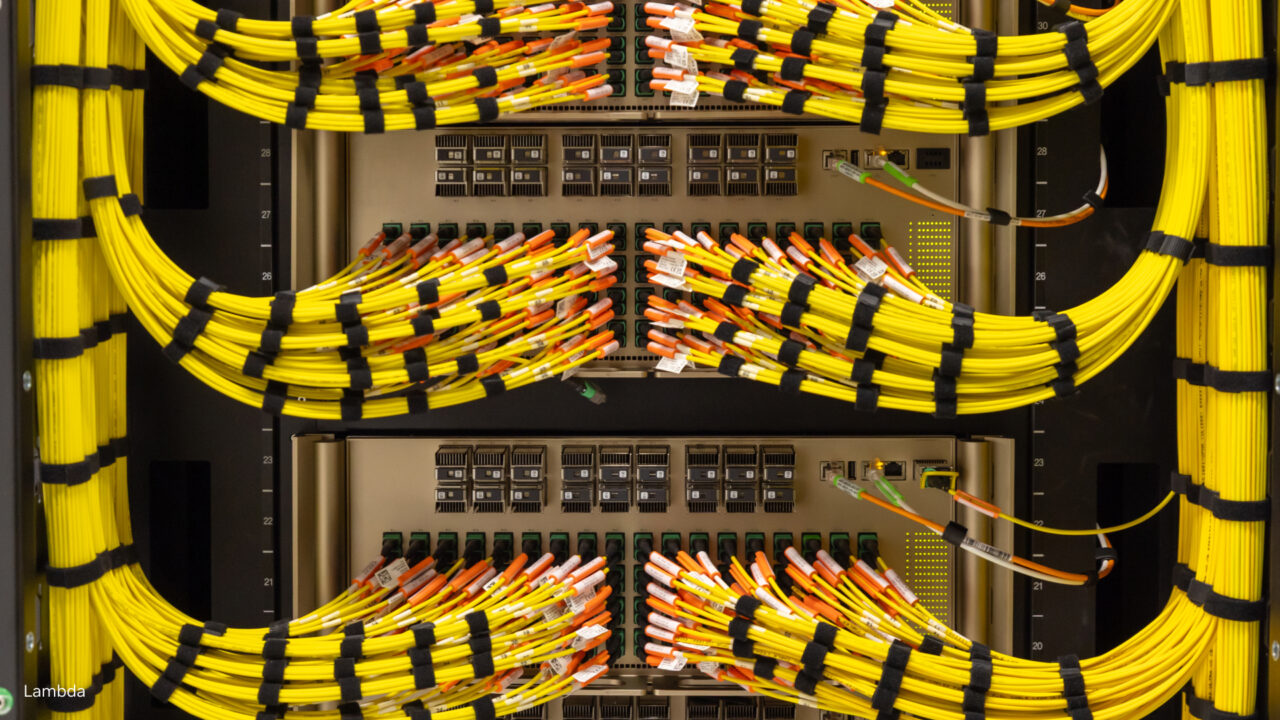
Image: Lambda via blogs.nvidia.com
What was announced, from Lambda's Nov 16, 2026 announcement (Business Wire, 08:45 ET) and NVIDIA's own blog post the same afternoon: the deployment uses NVIDIA Photonics switches — 144 ports at 800Gb/s, liquid-cooled, with 18 removable external light sources — to connect more than 10,000 NVIDIA Blackwell Ultra GPUs, in GB300 NVL72 racks on NVIDIA's account, at Lambda's Quebec campus. The campus figures are Lambda's: 142MW of power secured, nearly 100% renewable energy, a guaranteed PUE of 1.2, and free cooling for up to 80% of the year. Co-packaged optics puts the optical conversion on the switch itself instead of in pluggable modules at the rack edge, which is why the networking layer — usually a fixed tax on large training runs — is the claim here.
Lambda's measured comparison against pluggable optics: identical throughput, with latency lower at every scale — 3.8% lower at rack scale and 10.1% lower at pod scale — and a median optics temperature of 36°C against 51°C. The bigger numbers in NVIDIA's post — up to 5x power efficiency and up to 15x higher reliability for Photonics — are NVIDIA's general claims for the technology, not figures measured at Quebec, and no switch count, absolute latency baseline or independent test was published. Treat the Quebec numbers as the deployer's own measurements, labelled as such.
What it means if you rent GPUs
For renters this is not a price or a product you can book — it is a signal about where large-cluster economics move next. On a multi-thousand-GPU training rental, the network decides how many of the GPU-hours you pay for turn into finished work; a networking layer that measurably cuts latency and runs cooler at 10,000-GPU scale is Lambda's argument that its clusters deliver more productive hours per dollar than the same GPUs wired conventionally. The honest renter's response is to ask for the evidence per deployment — Lambda has now published its own, which gives buyers a concrete set of figures to ask rival cluster providers to match. Single-card and small-cluster renters are unaffected today; the board's Lambda prices are unchanged.