NEWS → · Models · Ant Group · inclusionAI
Ling-3.2-air: Ant Group drops a 124B MIT-licensed multimodal MoE — a four-GPU node job
Nov 23, 2026
Ant Group’s inclusionAI published the weights for Ling-3.2-air on Hugging Face on Nov 23, 2026, with no launch post — the model card is the announcement. It is a native multimodal mixture-of-experts model (text, image and video in) with 124 billion total parameters and only 5.5 billion active per token, a 262,144-token native context, block-FP8 weights and the MIT licence, so it can be self-hosted commercially today. The picture is the model’s own architecture diagram from its card.
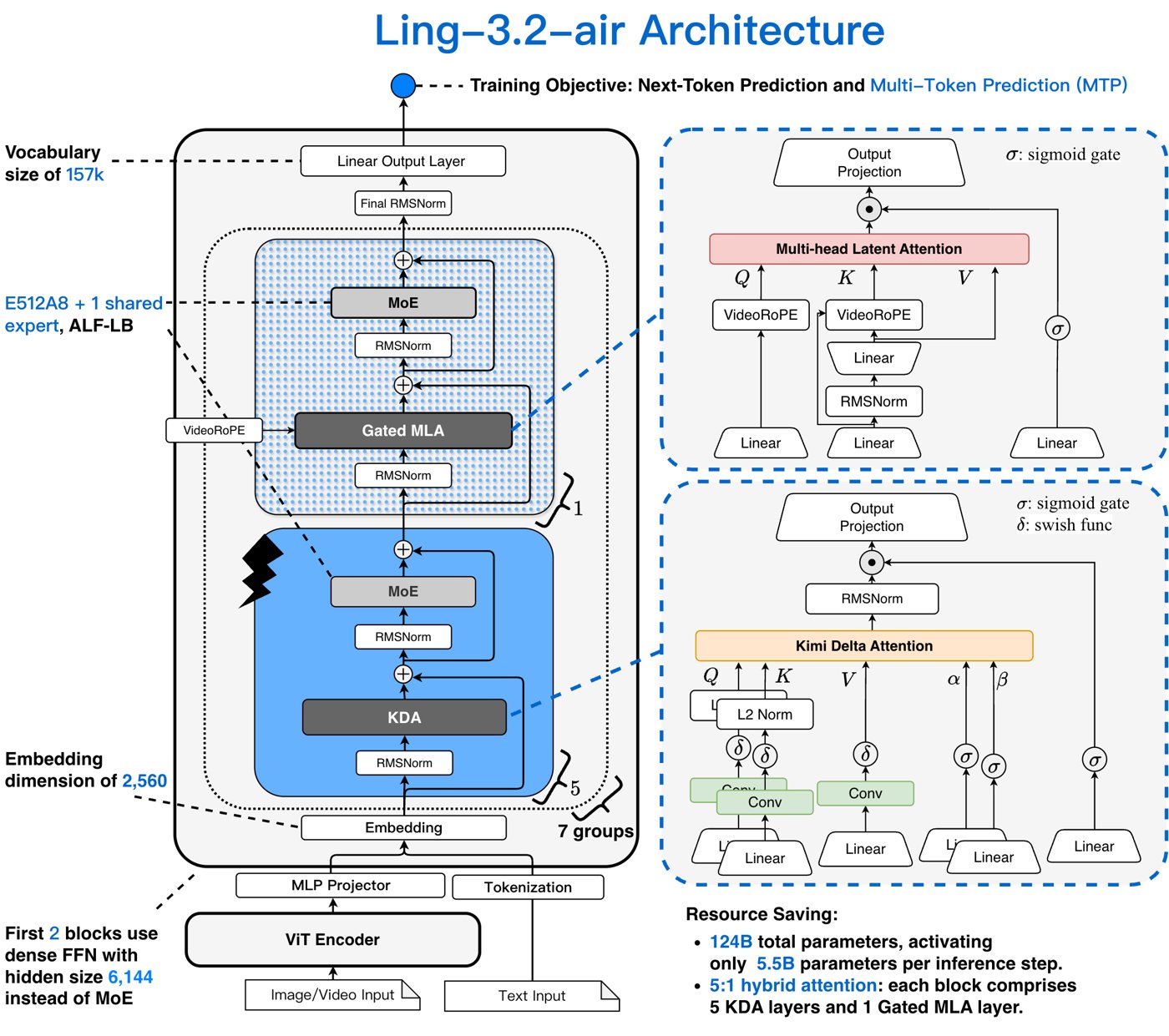
Image: inclusionAI (Ant Group) via huggingface.co
What shipped, from the model’s own Hugging Face card and repository record, read Nov 23, 2026: a hybrid-linear MoE — 35 Kimi Delta Attention layers and 7 gated MLA layers in a 5:1 mix, 512 routed experts with 8 active per token plus one shared expert, a vision encoder for image and video input, and a 157,184-token vocabulary. The weights ship in block FP8 (roughly 129 GB across the repo’s shards) under the MIT licence, public and ungated. SGLang support is day-0: the card’s recommended recipe runs the full 256K context at tensor parallel 4, and a vLLM fork recipe is published alongside.
The gains are as reported on the card, against its predecessor Ling-3.0-flash-VL: AutomationBench-AA rises from 15.7% to 61%, the GDP.pdf all-pass rate from 8.4% to 16%, AA-Briefcase v1.1 Elo from 987 to 1,340, and Terminal-Bench 4.0 from 0% to 27%. The card also reports a score of 23 on the Artificial Analysis Intelligence Index v5.0.1. These are the maker’s own published figures, not independently re-run by this desk — the pattern they describe is a document-and-workflow-automation specialist, not a general reasoning leap.
What it means if you rent GPUs
For builders, the honest headline is the serving shape. Only 5.5B parameters fire per token, but all 124B have to sit in memory: the card’s own recipes put it on four 141 GB-class GPUs (H200-class) or a four-GPU Blackwell node (B300 / GB300) at tensor parallel 4, or eight 80 GB cards (H100-class) at tensor parallel 8. That is a node rental, never a single card — the same class of commitment as its 560B sibling Ling-3.1-flash-1019, at roughly a quarter of the weight. What you get for the node is an MIT-licensed multimodal model aimed squarely at document processing and workflow automation, with day-0 SGLang support and no licence negotiation. It is in the model catalogue now, with the fit maths on its page.