NEWS → · Models · MemTensor · NVIDIA
MemT-1.0-Pro: a 554B memory-native model built on NVIDIA's Nemotron-3-Ultra, open-sourced today
Nov 24, 2026
MemTensor today, Nov 24, 2026, released and open-sourced MemT-1.0-Pro, a memory-native model built on NVIDIA's Nemotron-3-Ultra backbone and trained with NVIDIA's Megatron tooling: 554 billion total parameters, 59 billion active, with a fixed-size persistent memory state instead of an ever-growing context cache. The picture is the maker's own architecture image from its release. One caution is printed up front, because it decides who can use this commercially: the weights carry the OpenMDW-1.1 licence, not a clean permissive one.
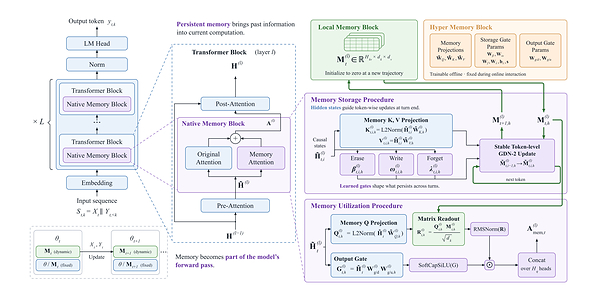
Image: MemTensor via PRNewswire
What shipped, from MemTensor's own release of Nov 24, 2026 and the model's Hugging Face card, both read first-hand: a 554B-total / 59B-active model on the NVIDIA-Nemotron-3-Ultra-550B backbone, with 4.23B trainable memory parameters and a fixed-size persistent memory state — the maker puts the storage saving at roughly 66× against a full KV cache at 128K of history. The maker's own reported scores average 53.08 across 11 memory benchmarks (the best among the parametric-memory methods it evaluated), with BEAM-1M at 41.80 and MemoryAgentBench at 23.87 — and the release itself notes that strong textual-memory systems remain ahead on some evaluations. These are the maker's figures, not independently re-run by this desk.
The licence is the story's fine print, printed exactly as the card states it: OpenMDW-1.1, following the Nemotron backbone. That is not Apache 2.0 or MIT, and this desk does not list the model as clean commercial open weights — anyone planning a paid deployment should read the licence terms first. The research paper behind the family dates to October, and the smaller Nano and Flash tiers to Oct 20; today's release is the Pro tier's own announcement.
What it means if you rent GPUs
For builders, the interest is the serving shape, not the parameter count alone. A memory-native model holds its state in a fixed-size memory rather than a KV cache that grows with every token of history, which is aimed squarely at long-running agents — the workloads where context storage, not raw compute, becomes the bill. At 554B total parameters this is still a multi-GPU node model by any memory arithmetic, and the OpenMDW-1.1 licence, not the hardware, is the first gate a commercial renter has to clear. It is a research-grade release with a real idea inside it, published with its maker's own caveats attached — which is how this desk prefers to receive them.