NEWS → · Open data · NVIDIA
NVIDIA opens Nemotron 3.5 Parse's training data and recipe — and clocks 20.44 pages a second on one H200
Nov 26, 2026
NVIDIA published the training data, fine-tuning recipe and speed work behind its compact document-parsing model Nemotron 3.5 Parse on Nov 26, 2026: three synthetic datasets totalling about 18.9 million image-and-annotation pairs, a public supervised-fine-tuning to GRPO recipe, and a speculative decoder, DFlash2, that NVIDIA measures at 20.44 pages per second on a single H200 at high concurrency. The model itself is not new — it is a 0.63B parser published earlier in 2026 under the OpenMDW-1.1 licence — what opened today is everything around it. The picture is NVIDIA's own first figure from the post: a page on the left, the model's structured extraction of it on the right.
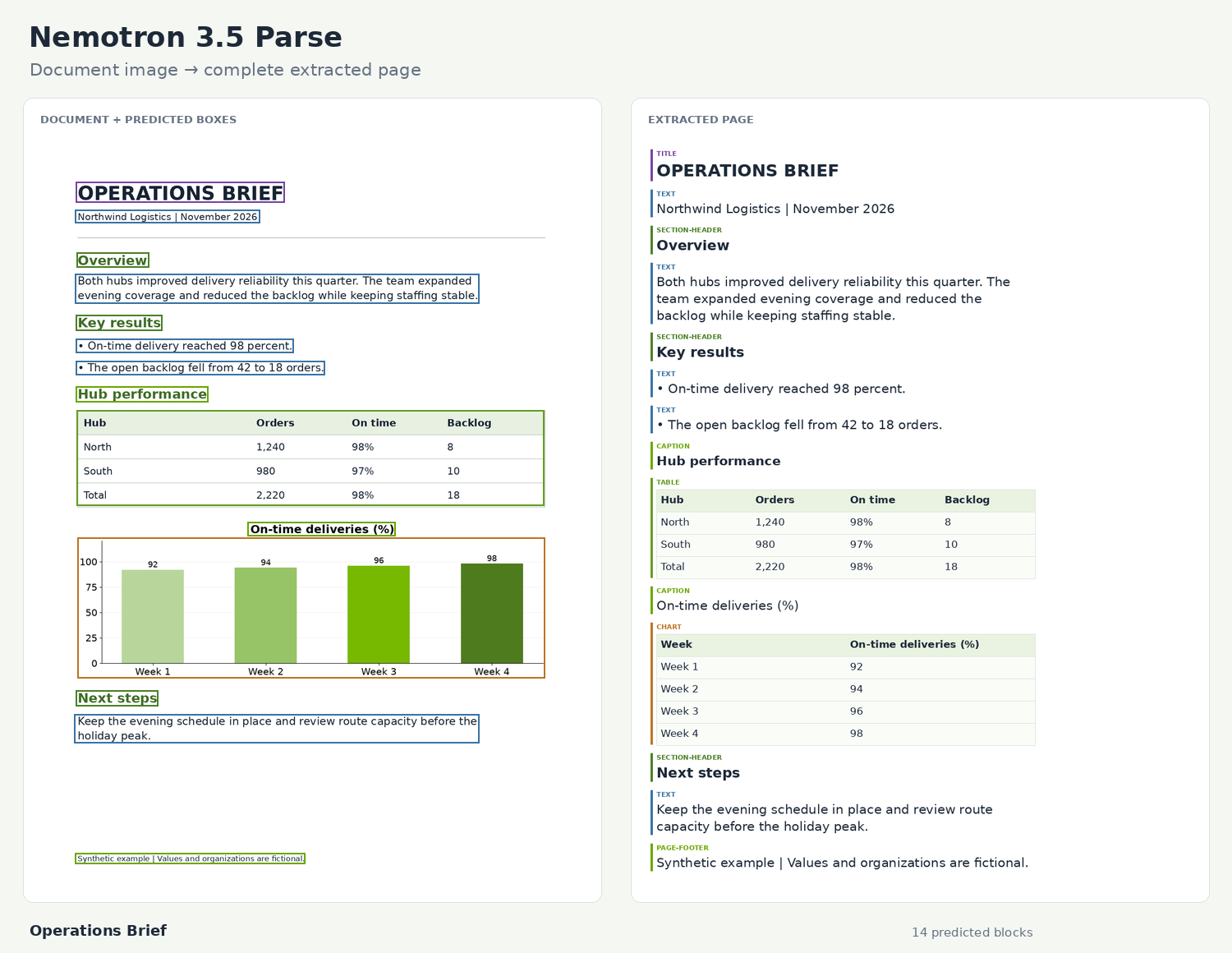
Image: NVIDIA via huggingface.co
What shipped, from NVIDIA's own post (Hugging Face, published Nov 26, 2026, 05:05 UTC) and verified against the repositories by this desk: Synthetic Charts V1 (9.98 million chart pairs), Synthetic Tables V1 (1 million table pairs) and OCR Synthetic Multilingual v2 (7.9 million multilingual pages); all three dataset cards list the CC-BY-4.0 licence in their own metadata, checked first-hand today. The recipe runs NeMo Automodel SFT then NeMo RL GRPO with vLLM generating candidates. On NVIDIA's matched development checkpoints — its own caveat: not the final model — the overall score rose 66.24 to 71.38 after GRPO, loop-flagged pages fell 126 to 29 and pages hitting the 9,000-token cap fell 185 to 35. Optional double- and triple-pass reprocessing adds 2.18 and 2.46 ParseBench points over single pass, at lower throughput.
The speed figures are NVIDIA's own measurements on one H200 in BF16 over the same 2,078 ParseBench pages: DFlash2 — a draft model proposing up to 32 tokens, about 14 accepted on average — lifts throughput 7.62× at concurrency 1 and 1.52× at concurrency 512 against Parse 3.5 with speculation off; at 512 that is 20.44 pages per second with DFlash2, 13.48 without, and 2.98 for the older Parse 2.0.
What it means if you rent GPUs
Run NVIDIA's own high-concurrency figure against the board and the workload gets a price: 20.44 pages a second is about 73,600 pages an hour, and at the board's best verified H200 rate (RunPod Community, $3.59 an hour, checked Nov 26, 2026) that is roughly $49 per million pages parsed — our arithmetic on NVIDIA's unverified throughput figure, printed as such, not a measurement. The bigger deal for builders is the data: document parsing is the unglamorous workload underneath most RAG and agent pipelines, and NVIDIA has now given away the synthetic data and the training recipe to adapt a small parser to your own document types instead of paying a hosted OCR API per page forever. The honest watch-outs: the throughput and quality numbers are NVIDIA's, on NVIDIA's own benchmark pages; the development-checkpoint gains are not the shipped model's scores; and the model's OpenMDW-1.1 licence is a model licence, not Apache or MIT — read it before building a product on the weights. A catalogue entry is added with this story.