NEWS → · Models · Shanghai AI Laboratory · InternLM
Sage S2.1 Flash: a 320B open science-agent model under MIT, with weights live and an eight-H200 reference setup
Nov 17, 2026
Shanghai AI Laboratory's InternLM team uploaded the weights of Sage S2.1 Flash to Hugging Face on Nov 15, 2026: a scientific multimodal agent model of 320 billion parameters (321.3 billion by the repository's own file metadata) with 18 billion active per token, released under the MIT licence in both full-precision and FP8 builds. Through its Sage SciPerception layer it reads more than ten kinds of scientific input — molecular graphs, crystal structures, protein sequences and 3D structures, spectra, X-ray diffraction, ECG, EEG and more — alongside text and images. This desk held the story for an official image; the model's card has since been published in full, the maker's own architecture diagram is in the repository, and it runs with the story. Every benchmark below is the maker's own — no independent harness has tested this model yet.
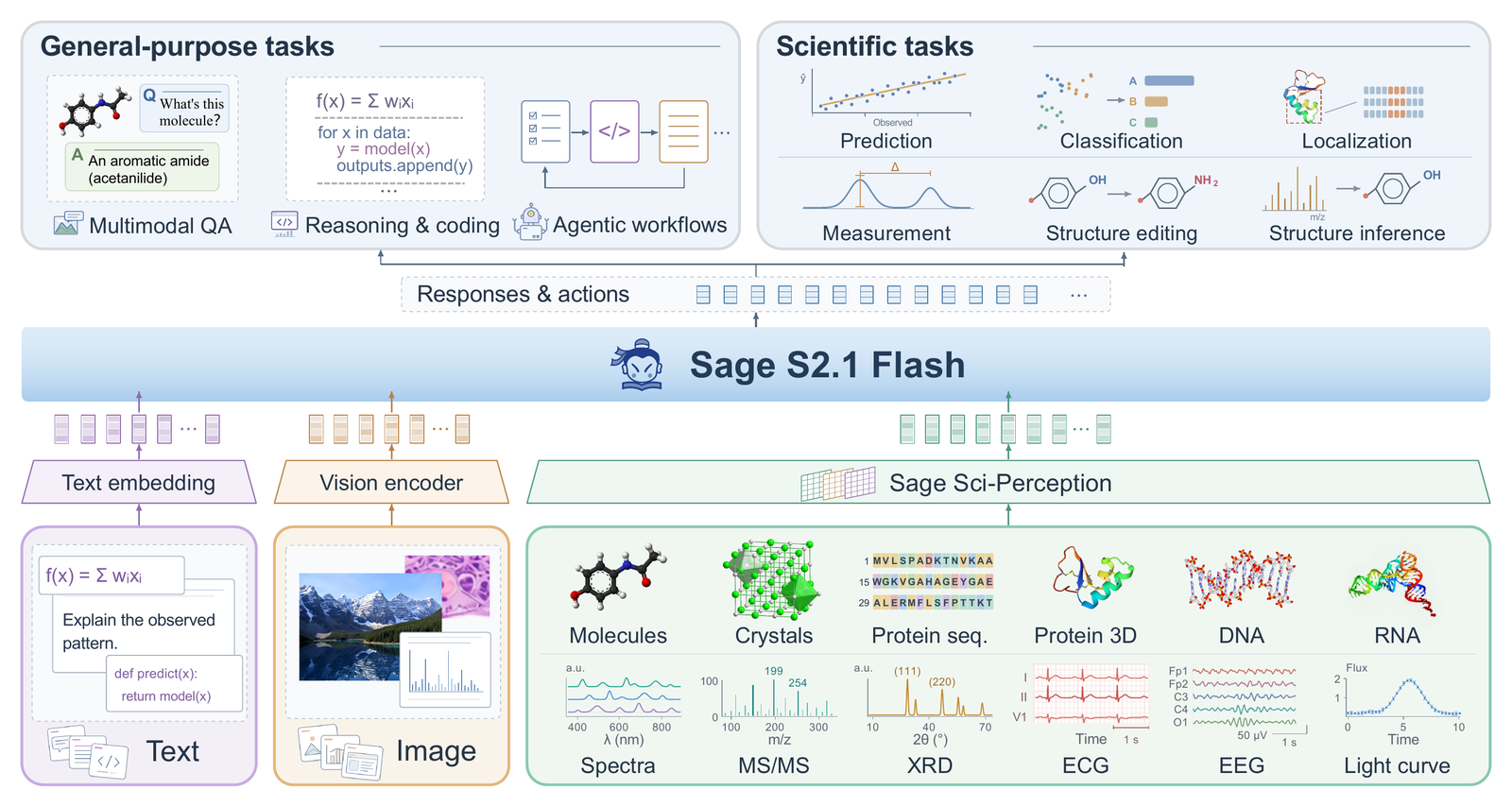
Image: Shanghai AI Laboratory / InternLM via huggingface.co
What dropped, from the model's own Hugging Face repositories, read first-hand: Sage S2.1 Flash is built on the GLM-5.3-Flash architecture, with 45 layers and 288 routed experts in its own config file, a maximum context of 1,048,576 tokens, and code and weights under the MIT licence — no revenue cap and no use restrictions beyond the licence notice. The full-precision weights total 642.8 GB across 129 files; an FP8 build is published alongside, at about 321 GB by the same file metadata. The scientific side is the point of the model: Sage SciPerception encoders project each scientific input type into the same representation space as text, so the model can run multi-round analysis — reading evidence, calling tools and specialist software, checking intermediate results and adjusting — rather than answering from a single pass. Deployment guides are published for vLLM, SGLang and LMDeploy; the maker's own example runs the model on eight H200 GPUs in tensor parallel, and the guides require custom code to be trusted at load time.
The maker's own evaluation, published on the model card: across its 15-benchmark headline comparison against five rivals, Sage S2.1 Flash placed first on four benchmarks and second on seven. Its clearest first is MLE-bench Lite, the machine-learning engineering test, at 90.3 against DeepSeek-V4.1-Flash-1017's 89.2; it also leads its table on OfficeQA Pro (72.2), Harvey LAB (25.0) and SpreadsheetBench 2 (37.1), and scores 87.9 on Terminal-Bench 2.1. These are InternLM's own measurements under its own harnesses, published with unusually full evaluation settings on its release site — detailed, but still the maker's numbers, with no independent replication and no hosted provider price anywhere yet. The model is now in our catalogue with its sizes worked from the repository's own files.
What it means if you rent GPUs
For model builders this is the largest open-weight science-agent release yet, and the licence is the cleanest kind: MIT, so a lab or a company can run it commercially without negotiating anything. The honest cost side is the footprint. At full precision this is a node, not a card — the maker's own reference setup is eight H200s, which at the cheapest verified H200 rate on our board (RunPod Community, $3.59 per GPU per hour, checked Nov 17, 2026) is about $28.72 an hour before storage and your own serving work; the FP8 build, at roughly half the memory, is the realistic starting point for smaller clusters, by memory arithmetic alone. Whether it earns that rent depends on benchmarks nobody independent has run yet — the maker's table is strong on exactly the agentic, tool-using work research labs pay for, and this desk will treat the first independent results, when they land, as the follow-up story.