NEWS → · Models · Tencent
Tencent releases Hy4 flash weights: a 220B MoE with 12B active and a 1M context — under a licence with a $50M trigger
Nov 18, 2026
Tencent published the weights of Hy4 flash on Nov 17, 2026 — three repositories (the instruct model, an FP8 build, and the pre-trained base) on Hugging Face, ModelScope and GitCode, a day after the model reached Tencent's API. The card, read first-hand by this desk, totals 220 billion parameters with about 12 billion active per token, native image input and a context window of 1,048,576 tokens. The release ships not under the plain Apache 2.0 of Tencent's earlier Hy models but under the Tencent Hy License, whose section 10.2 requires a separate written licence from model-as-a-service operators above US$50 million in revenue or 100 million monthly users. The picture is Tencent's own diagram of DFly2, the built-in speculative-decoding drafter that ships inside the model.
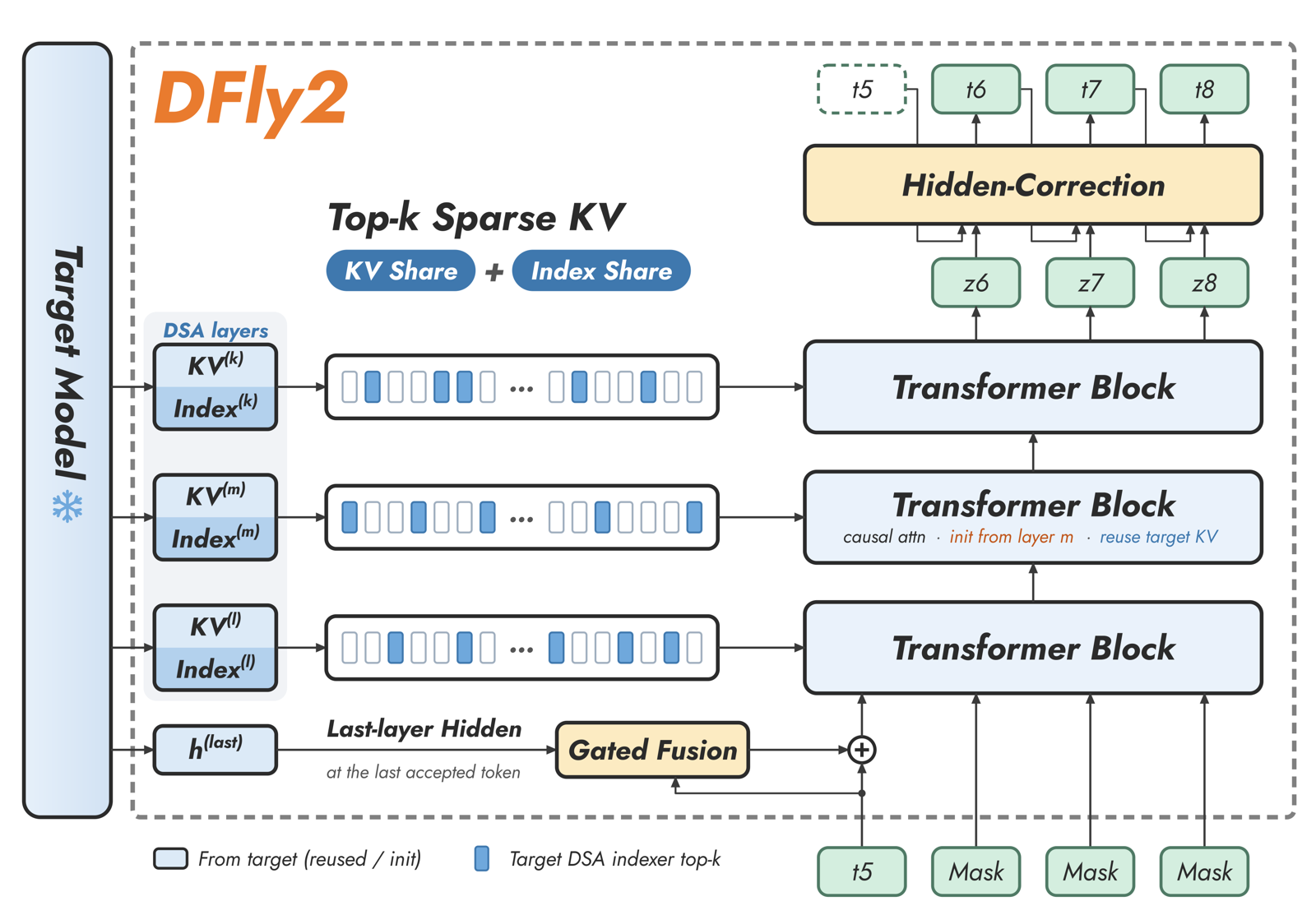
Image: Tencent via huggingface.co
What is in the repositories, from the model's own card: the 220B total is a 155.5B-parameter language backbone plus 63.5B of Engram N-gram embedding tables, a 0.43B SigLIP2 vision encoder and the 0.85B DFly2 drafter; per token it activates 11.3B text parameters plus the vision encoder. The backbone has 42 layers — one dense, 41 MoE layers with 512 routed experts of which 16 fire per token — hybrid sparse and sliding-window attention, and a KV cache Tencent says is one twenty-fourth the size of Hy3's. Serving recipes are published for vLLM and SGLang, including an official prebuilt vLLM image; Tencent says that combining 4-bit quantisation with DFly2 pushes decoding past 150 tokens per second (the maker's own figure). The licence is the change from family practice: Hy3 and the Hy4 preview shipped under Apache 2.0; Hy4 flash's Tencent Hy License v1.0 is an Apache derivative adding section 10.2 — above US$50M worldwide gross revenue in any 12 months, or over 100M monthly active users, a model-as-a-service operator needs Tencent's separate written licence; section 10.3 exempts internal use.
The evidence is, so far, entirely Tencent's. On its internal WorkIndex suite the maker scores Hy4 flash at 42.1 against the Hy4 preview's 39.7, at one thirteenth of the preview's cost per task; in its own blind test with 85 internal users across 259 tasks, satisfaction was 2.79 out of 4 against Claude Haiku 5.5's 2.81, with the lowest cost per task and the shortest median completion time (6.7 minutes) in its set. No independent harness has scored the model — Artificial Analysis has no page for it as of Nov 18 — and support in the Transformers library is still a pull request, not a release. The model is now in our catalogue with its sizes worked from the card's own parameter table.
What it means if you rent GPUs
For self-hosters the serving maths are friendly for a model this size: only 12B parameters are active per token, and the FP8 build — about 220GB by memory arithmetic from the card's parameter count — fits on two H200s (282GB combined), which at the cheapest verified H200 rate on our board (RunPod Community, $3.59 per GPU per hour, checked Nov 18, 2026) is about $7.18 an hour before storage and your own serving work; the full-precision build, about 440GB, wants four H200s on the same arithmetic. The watch-out is not the hardware, it is the licence: a small team can self-host freely, including commercially, but a hosted service that grows past the $50M revenue or 100M-user lines owes Tencent a separate agreement first — exactly the kind of clause to read before building a product on these weights, and the reason this desk does not file Hy4 flash under plain open-source licences in the catalogue.