NEWS → · Models · PrismML
Ternary Bonsai 2.5 27B: a 27B agentic model in 5.93 GB — FP16-level tool calling on one small card
Nov 24, 2026
PrismML released Ternary Bonsai 2.5 27B on Nov 24, 2026: a 27-billion-parameter model built on Qwen3.8-27B, written in ternary 1.76-bit weights, so the whole model is a 5.93 GB GGUF file against 53.8 GB at FP16 — Apache 2.0. The upgrade over Bonsai 2 is agentic staying power: on PrismML's own benchmarks it averages 77.2 across five tool-calling suites against 77.7 for the full-precision model, and its agentic-coding score rises from about 63% of FP16 to about 90%. The picture is the cover of PrismML's own whitepaper for the release, with its headline figures.
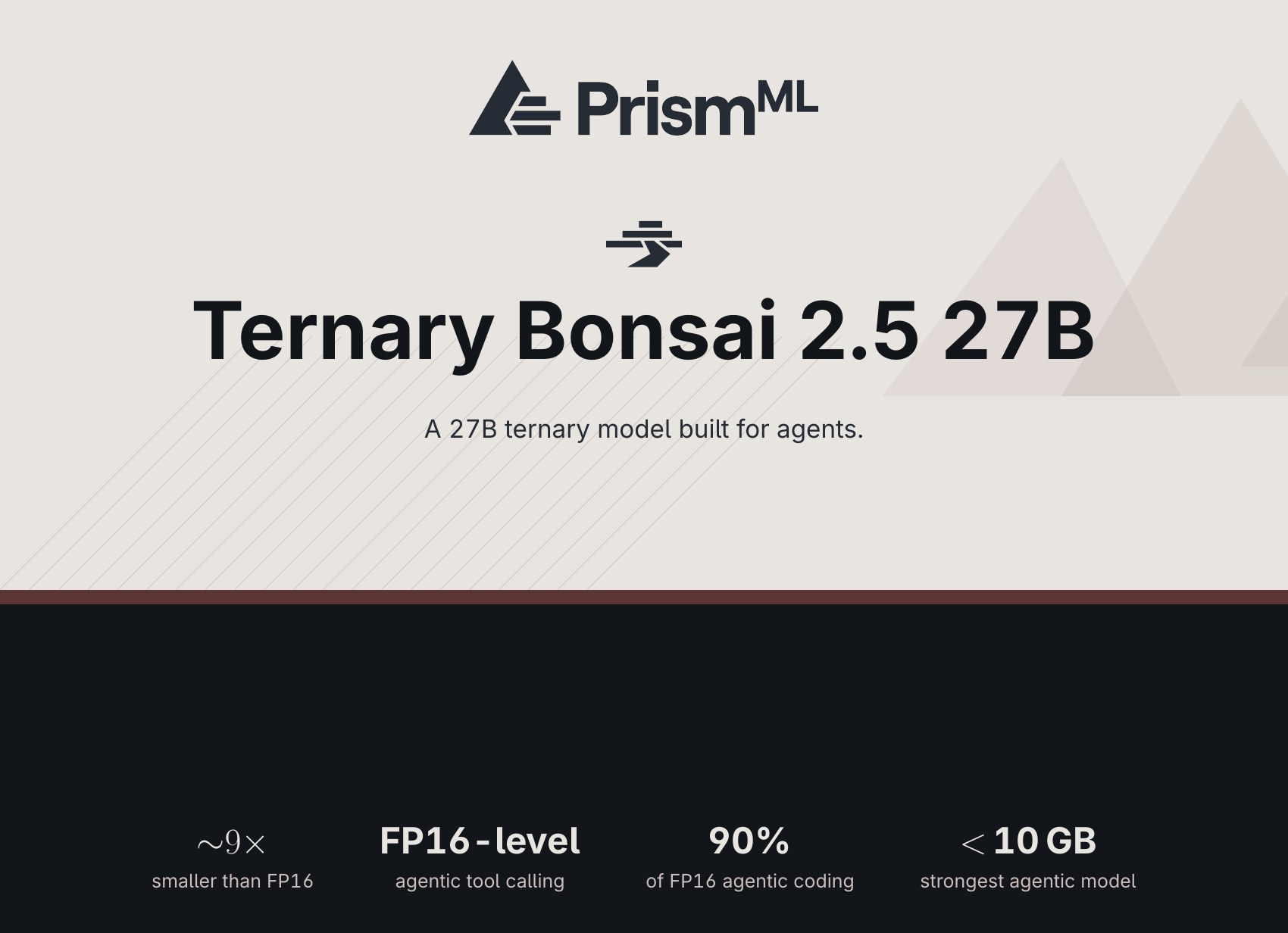
Image: PrismML via github.com/PrismML-Eng
What shipped, from the model's Hugging Face card, PrismML's release post and its whitepaper, all read first-hand by this desk: a hybrid-attention 27B (24.35B language weights, a 0.47B vision tower shipped as a separate optional file, 262,144-token context), released as GGUF builds — PQ2_0, PTQ1_0 and Q2_0, each also in a multi-token-prediction variant that the maker says decodes 1.5–1.8× faster. It runs via llama.cpp on NVIDIA and Intel GPUs and via MLX on Apple devices. On the maker's own table, SWE-bench Verified rises from 60.8 (Bonsai 2) to 75.6 against the FP16 base model's 80.6, DeepSWE from 0 to 27.0, and Terminal-Bench 2.1 from 52.8 to 60.1; AppWorld recovers from 51.2 to 90.5 against 93.2 at FP16. Every one of those scores is PrismML's, measured its way, and is reported here as the maker's — this desk has not re-run them. Its stated speeds are likewise the maker's: 291 tokens a second on one H100 and about 204 on an RTX 4090, both with MTP on.
The honest edges travel with the release: general capability still trails FP16 (82.1 against 84.3 averaged over the maker's five categories), LiveCodeBench dipped slightly against Bonsai 2 on the same table (83.0 against 83.8), and a ternary model this compressed lives or dies on long tool chains — exactly the workload its maker says it fixed, and exactly what an independent re-run should test first.
What it means if you rent GPUs
For renters and builders this moves the floor, not the ceiling: a 27B-class agent that fits in under 6 GB runs on the cheapest card on the board — or on a laptop, with no rental at all — and Apache 2.0 lets it ship inside a product. The comparison that matters is against ordinary low-bit GGUF builds of the same base model, which the maker's table puts behind it on tool calling at larger sizes. Treat the benchmark claims as the maker's until a third party reproduces them; the file sizes, licence and formats are facts from the repository itself. A catalogue entry is added with this story, and a one-small-card deploy guide is proposed for approval.